New Titles 07/08
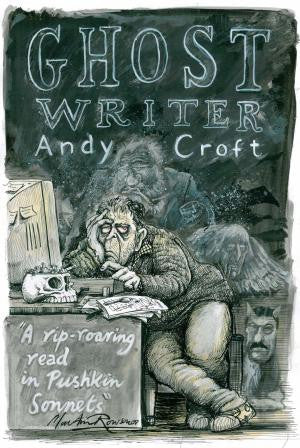
The dedication of a novelShould be a place to shout and sing,And yet I feel I ought to grovelFor asking you to read the thing.SO Middlesbrough-based Andy Croft introduces his latest venture, a verse novel centred on an author's struggle to write a biography of a minor 1930s poet. Croft calls the Pushkin-style sonnets in which it is written "these unheroic slapstick lines", but, sustained over more than 70 pages, they seem the very opposite - an heroic, if exhaustive, tour de force.Yet Croft set himself another task - to work in a theme or two from Hamlet, signalled by the name of one character, Claud King. The publisher's blurb also says "Great cover by Martin Rowson" - which it is.
Harry Mead
How Fee dumped Tod by txtANDY CROFT’s handicraft is stretched to the limit in this ambitious project – to produce a novel based on Hamlet, entirely in verse and Pushkin sonnets.But he rises to the challenge magnificently.Once the less poetic reader has overcome the daunting prospect of starting such a long poem, he or she will find it gripping enough to read in one sitting.The Hamlet plot is full of intrigue and brought bang up to date, with plenty of powerful political points, and bags of humour.It is about a modern-day author, Tod Prince, writing a biography about a 1930s poet who fought for the Republicans in the Spanish Civil War. He comes under various competing pressures to modify it from his publisher (who has a personal axe to grind), the ghost of the subject himself, and the ghosts of his wife and comrade.The novel has much to say about the nature of the modern-day media and publishing business, and what the Spanish Civil War was all about – from a communist perspective.The self-imposed restraint of the format leads to some strange rhymes and line breaks, but this amuses rather than distracts. One example is:This morning’s Guardian says the odds-On favourite book this year is Tod’s.Woven into the plot is Tod’s volatile sexual relationship with Fee. This includes a hilarious passage where he is vexed to be dumped by text:lst nite ws so humili8ingnxt tme u fncy celebr8ingfnd som1 else to hold yr h&i 1der if u undrst&ths tme it is gdby 4evawr brking up, ur batrys fl@& u r actng lk a pr@as sum1 said: the ?s wevau wnt 2b or nt 2ba tossa all ur lfe. x Fee.
Mike Pentelow
Andy Croft is the author of a neglected biography of the neglected communist poet Randall Swingler. He spent years writing the book and longer finding a publisher. Tod Prince, the protagonist of this long narrative poem in Pushkin stanzas, is writing the biography of a minor 1930s communist poet, Rex Dedman. The story follows the shape of Hamlet. Croft, to his credit, goes out of his way to be unfashionable. The Pushkin stanza is a tough discipline (for both writer and reader) and quite out of keeping with the customary forms of contemporary writing. The story told here features a cast of lefties, bohemians, supporters of lost causes – personal or political. It’s hard to think of a book further from the poetic mainstream. It would give the judges of the Forward Prize a fit of the vapours. But it’s great fun. Croft is too astute to try to make such a poem serious in its conception, though it’s serious enough in what it touches on. The writing is excellent and occasionally, through the restraint of forcing an idea into the form, comes up with something really memorable: If pain’s to be truth’s only measure Dishonesty must be a pleasure. For the most part, the language is working hard to drive the narrative, while at the same time setting up a web of associations and allusions which arise from the poem barely perceptibly and nestle in the mind. In this way, the poem is a combination of a surface which appears obvious and fairly predictable and a much more subtle figurative, almost ghostly presence, whose purpose is to haunt long after the initial fun has paled. There are many points at which you will laugh out loud, something pretty rare in reading modern poetry, and the thing rolls along so pleasantly you’ll find yourself getting to the end of it hardly noticing you’ve turned the pages. It’s a splendid, funny, clever, witty read which seems to me to point to the narrow range of today’s publishing. I’m sure a big publisher would run a mile from something like this. All the more reason to congratulate Five Leaves. I’m pleased to say that part of the poem was up on the Penniless Press website for a while. I hope people who read it there will buy the book. It’ll cheer you up, make you laugh and think and it blows a hole through the conventional notion of a mode of modern writing to which everyone should adhere.
Tod Prince, the hack hero of Ghost Writer (whose author, Andy Croft, is not to be confused with Andrew Crofts, who is an actual ghost writer), dreams of being shortlisted for the "Boswell prize", alongside "My Humble Path, by Julie Burchill, / Wayne Rooney's life of Winston Churchill, / The Answer's No, by Germaine Greer, / And Irvine Welsh's new Top Gear." Tod's would-be contender is a life of Rex Dedman, a minor poet who fought in the Spanish civil war. But, after amassing research for 10 years, Tod is haunted by the common biographer's anxiety: "As he collects the jigsaw pieces / His sense of Rex somehow decreases." Then he gets a literal haunting: Rex turns up, demanding that Tod complete the work, but with Rex's amendments. There are further hauntings; and Tod's publisher Claud King (the names "King" and "Prince" are not accidental), who was with Rex in Spain, has his own reasons for wanting the book to appear.Ghost Writer, you will have noticed, is a novel in verse - the Pushkin stanzas also used by Vikram Seth in The Golden Gate. Any writer adopting such a scheme is bound to force his material from time to time. But Andy Croft tells his story with wit and brio.
Have you read The Ghost Writer by Croft, Andy? - Add your own review